 Cancun Mexico Snorkeling
The Best Time to Snorkel in Cancun: Seasons, Months and Hours That Matter
The best time to snorkel in Cancun is the dry season, December to April, when the wind lies down and the water off the reef runs clearest. This guide maps the whole year around that fact: what each month trades, when sargassum and hurricanes bite, and which trip fits which window. Every figure traces back to the full Cancun snorkeling comparison.
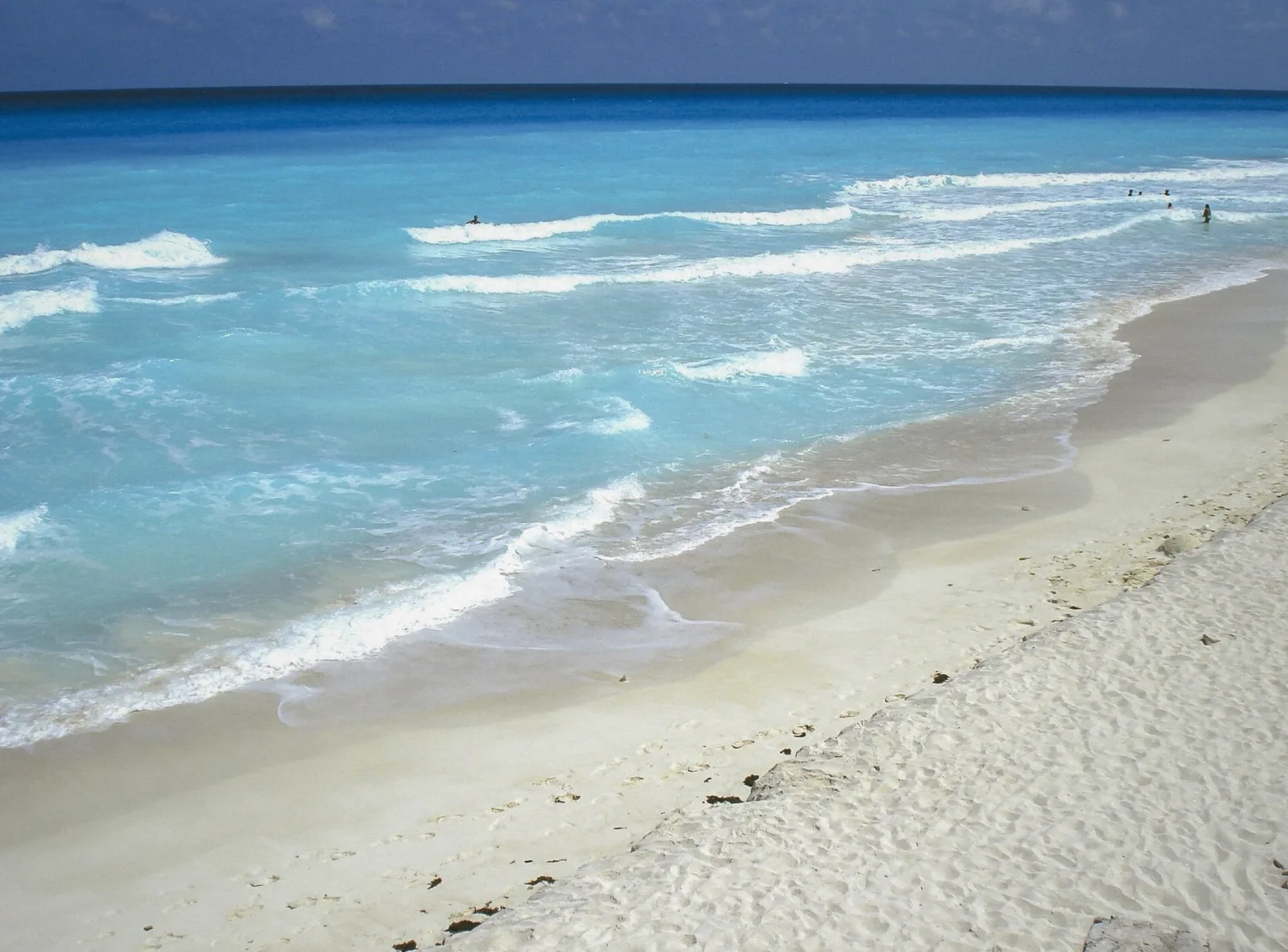
The Hotel Zone beach at Playa Gaviota Azul, where most snorkel boats start the day. Photo: Matthew T Rader (CC BY-SA 4.0) via Wikimedia Commons
Quick answer Dry season December to April gives the calmest, clearest water, mornings beat afternoons, and the whale shark window runs late May to mid-September.
The best time to snorkel in Cancun is the dry season from December through April, when the sea is at its calmest and clearest and water temperatures hold around 26 to 28 C (79 to 82 F). Within any given day, go in the morning, because trade winds rough up the surface by the afternoon in the windier months. Two special windows sit outside that rule: whale sharks gather north of Isla Mujeres from late May to mid-September, and sargassum landings on east-facing beaches are worst roughly May to July, which is one more reason the dry season wins for reef-focused trips.
Key takeaways
- December to April is the calm-water window. See the five-stop Reef & MUSA boat snorkel that runs it best.
- For the whale shark season detour, read our guide to whale shark snorkeling near Cancun.
- Want the whole field at a glance, prices included? Open compare all Cancun snorkeling trips.
- Pair the timing with the water: the snorkeling spots guide maps every reef a Cancun trip can reach.
The seasons in Cancun, plainly
Cancun does not have a snorkeling season in the strict sense. Boats run all year. What changes is the quality of the water and the character of the day, and those split cleanly into three blocks.
Dry season, December to April
This is the core answer. The listing data and climate pattern line up: December to April brings the calmest, clearest water of the year, with sea-surface temperatures of about 26 C (79 F) from December through March and 27 to 28 C (81 to 82 F) through April and May. For someone whose whole trip is built around the reef, the MUSA statues or El Meco, this is the window where visibility and boat comfort both peak.
The trade is volume. December to April and the Easter weeks are the crowded and priciest weeks on the water, so the same $99 five-stop boat that feels like a private run in a shoulder month can be fully booked days ahead in high season.
Warm and wet, June to October
Sea temperatures peak at about 29 C (84 F) from June through October, which is bathwater by any standard. The catch is that this block overlaps hurricane season, which runs June to October and peaks between August and October according to the National Hurricane Center. In practice most weeks are fine and hot, and a direct hit is a lottery, not a certainty.
The honest framing is risk, not doom. Book trips with free cancellation up to 24 hours ahead, which every one of the listings compared here in our catalog offers, and you carry almost no weather exposure on the booking itself.
Shoulder, November and May
November cools to about 27 C (81 F) and sits after the hurricane peak and before the high-season crowds. May is the hinge at the other end: warm 27 to 28 C (81 to 82 F) water, before the heaviest sargassum landings of early summer and before the winter crowds return. These two months are where a flexible traveler gets high-season water quality on shoulder-season terms, meaning lighter boat loads and softer prices than the December to April block.
The numbers in one place
Sea-surface temperature is the figure travelers ask about most, so here is the full set in one block rather than buried in prose.
Sea temperature by period
| Period | Sea-surface temperature |
|---|---|
| December to March | 26 C (79 F) |
| April to May | 27-28 C (81-82 F) |
| June to October | 29 C (84 F) |
| November | 27 C (81 F) |
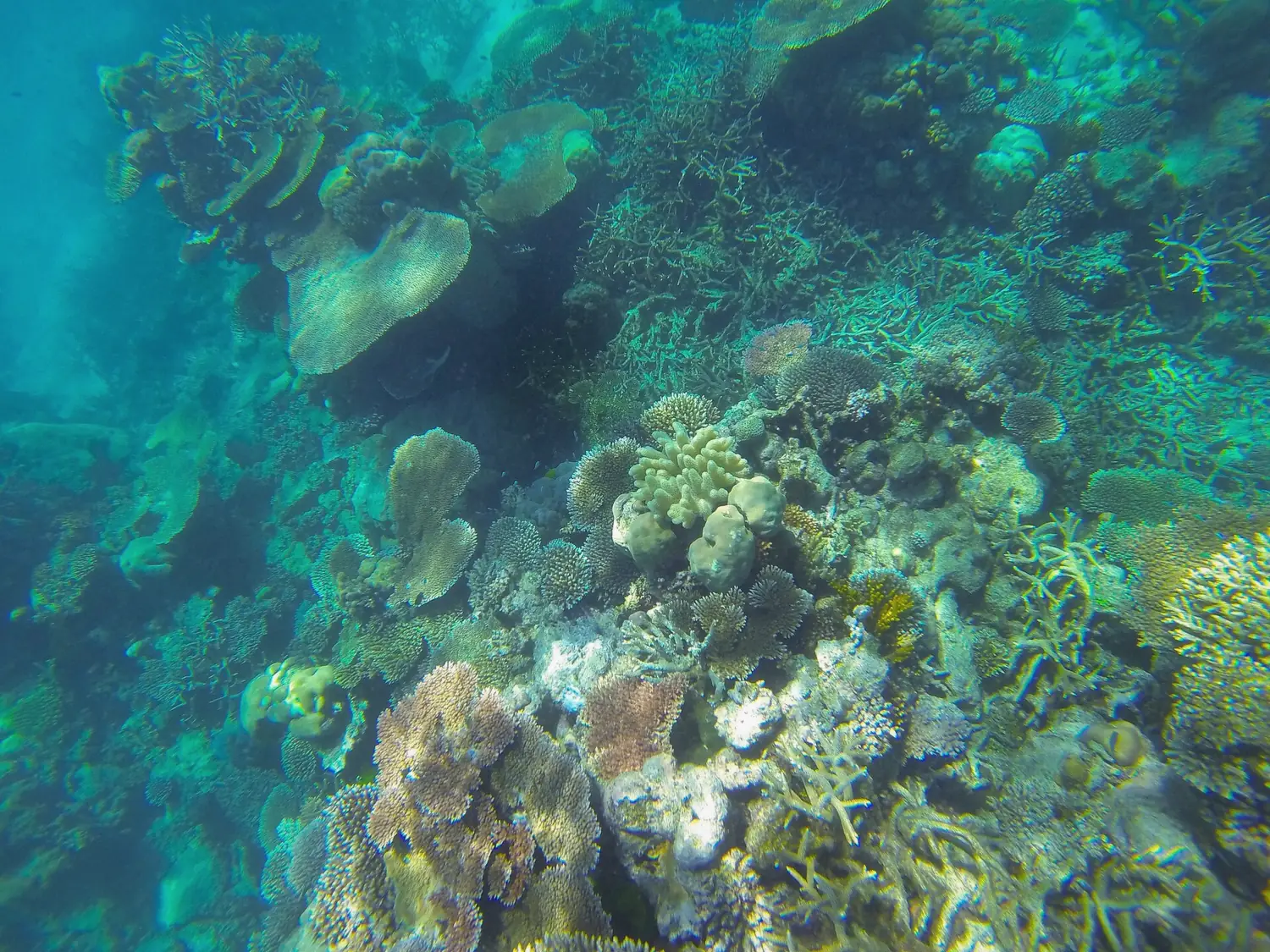
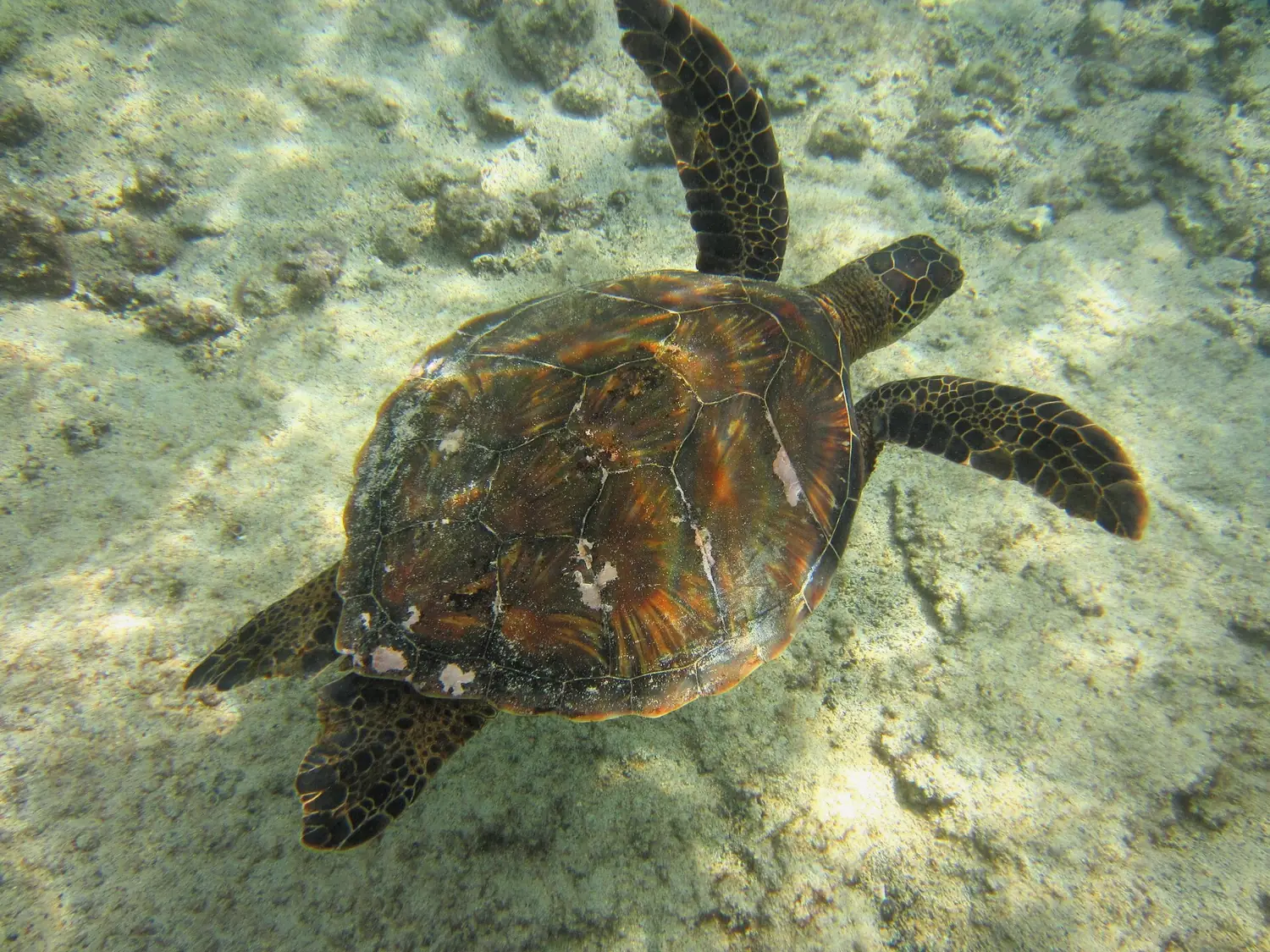
Illustrative photo. Shallow reef water like this is what the dry season delivers off Cancun. Photo: Dmitry Brant (CC BY-SA 4.0) via Wikimedia Commons
Best hour of the day to snorkel in Cancun
Month is half the answer. Hour is the other half, and it matters more than most first-time visitors expect.
Mornings win, for a mechanical reason
In the trade-wind months the sea is calmer in the morning and roughens through the afternoon as the wind builds. That is not folklore, it is the daily wind cycle, and it has three knock-on effects. Visibility is better before the surface gets churned.
Boat rides are smoother before the chop arrives, which matters enormously for anyone prone to seasickness on the run out to El Meco or Manchones. And the fish are simply more active before the midday boat traffic piles up over the same reef.
But check the departure board anyway
Here is the wrinkle. The dedicated MUSA museum run departs once daily at 11:30 am, so the pure museum-first itinerary is, by scheduling, an afternoon-leaning trip no matter what the wind does. The two-hour route spends both immersions on the more than 470 statues and the Manchones reef around them, with one instructor per six snorkelers.
If morning calm is your priority, the five-stop Reef & MUSA boat snorkel or the Puerto Morelos reef snorkel, which collects you at your hotel at about 11:30 am for a 2.5-hour run, are the closer fits. The Isla Mujeres catamaran and the private half-day catamaran are full and half-day formats where the snorkel stop lands wherever the captain puts it in the day.
A note on the sun
Midday in Cancun is fierce on exposed skin in every season. The reef-protection rules solve this for you. Regular sunscreen is banned on the five-stop boat as a reef-protection measure, and the MUSA museum run does not permit sunscreen before entering the water at all.
The practical answer, in any month, is a rashguard or long-sleeve shirt rather than a bottle of lotion. That keeps you compliant, keeps the reef cleaner and saves you from reapplying anything between immersions.
Hurricane season and what it actually means for your booking
Hurricane season is the phrase that scares people off summer trips to Cancun. The reality is more manageable than the phrase suggests, provided you book with the cancellation terms in view.
The dates and the peak
Hurricane season in the Atlantic basin runs June to October, and the National Hurricane Center tracks every system from formation onward. The statistically busiest stretch is August to October. June and July can be perfectly calm, and the 29 C (84 F) water of that block is the warmest of the year.
Storms are a probability, not a schedule.
How the tours handle it
Every trip in our catalog carries free cancellation up to 24 hours in advance for a full refund, and several go further. The MUSA museum snorkel states that if weather moves the start by more than 30 minutes you may cancel for a full refund, which is an unusually explicit weather clause. The speedboat jungle tour notes that its itinerary order can shift with lagoon conditions, and the private catamaran only hoists its spinnaker when weather allows.
The operators in this market are practiced at rebooking around weather. Your job is simply to not prepay a non-refundable rate, and on these listings you do not have to. Reserve Now and Pay Later is available across the board.
The checklist before you book in season
- Confirm the listing offers free cancellation up to 24 hours before departure
- Prefer Reserve Now and Pay Later so money leaves your account late
- Keep a flex day in your itinerary for a blown-out morning
- Check the National Hurricane Center outlook in the days before you fly
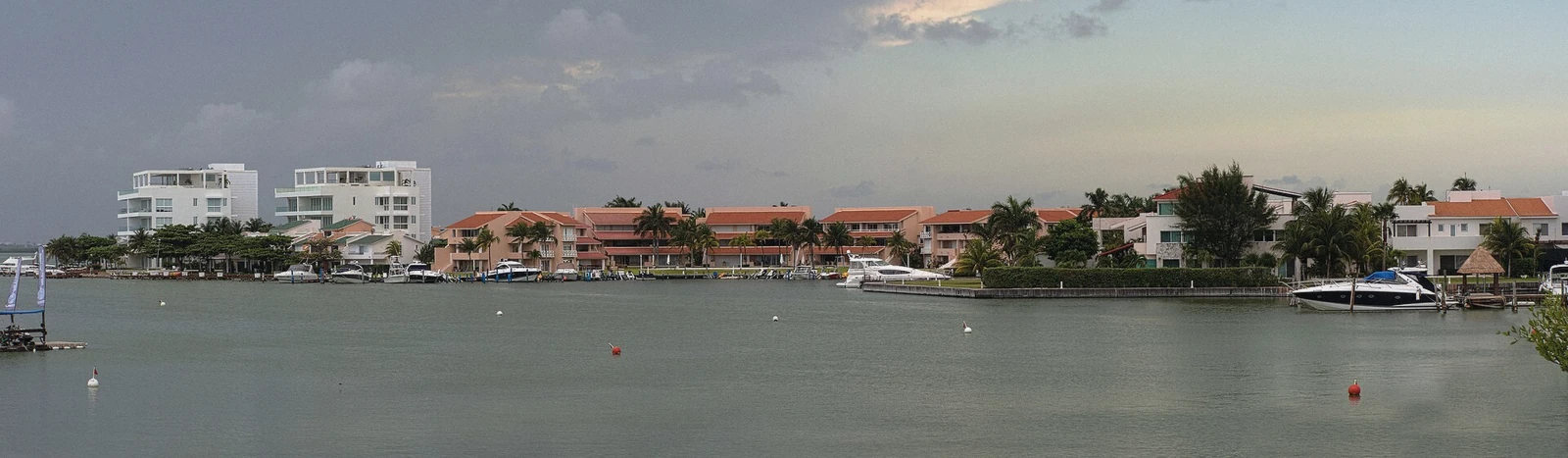
The calm water of Laguna Nichupte, where the speedboat jungle tour starts its run. Photo: Carlos Valenzuela (CC BY-SA 4.0) via Wikimedia Commons
Sargassum: the honest version
Sargassum is the seaweed question every Cancun traveler asks, and it deserves a straight answer rather than a promise.
When it lands and where it bites
Sargassum landings are worst roughly from May to July on the east-facing beaches of the Hotel Zone, where the open Caribbean pushes rafts of it ashore. Nobody can promise you a clean beach on a given week, and we will not. What we can say is what the pattern shows and what the tours do about it.
The offshore reef sites are a different story
The reef sites the snorkel boats use sit offshore and are mostly unaffected by beach landings, and boats can re-route around surface slicks when they appear. El Meco, Manchones, Punta Nizuc and the Puerto Morelos reef are working reef environments, not swim-off-the-sand spots, so the beach pileup you see in photos does not translate directly to what you see in the water. One listing goes further than the rest.
The private half-day catamaran guarantees sargassum-free swimming water, and its route to El Meco reef and Playa Norte gives the crew room to pick the clean side of the island on the day.
What this means for your timing
If a seaweed-free beach is central to your trip, the dry season from December to April sidesteps the worst of the landing window entirely. If you are traveling in early summer, pick trips that snorkel from boats rather than from the sand, and weight your expectations toward the reef rather than the shoreline. The MUSA museum snorkel and the Puerto Morelos reef snorkel are both boat-only water time, which is exactly the shape you want in sargassum months.
- Worst landings: roughly May to July on east-facing beaches
- Offshore reef sites: mostly unaffected
- Boats: can re-route around surface slicks
- One listing, the private half-day catamaran, guarantees sargassum-free swimming water
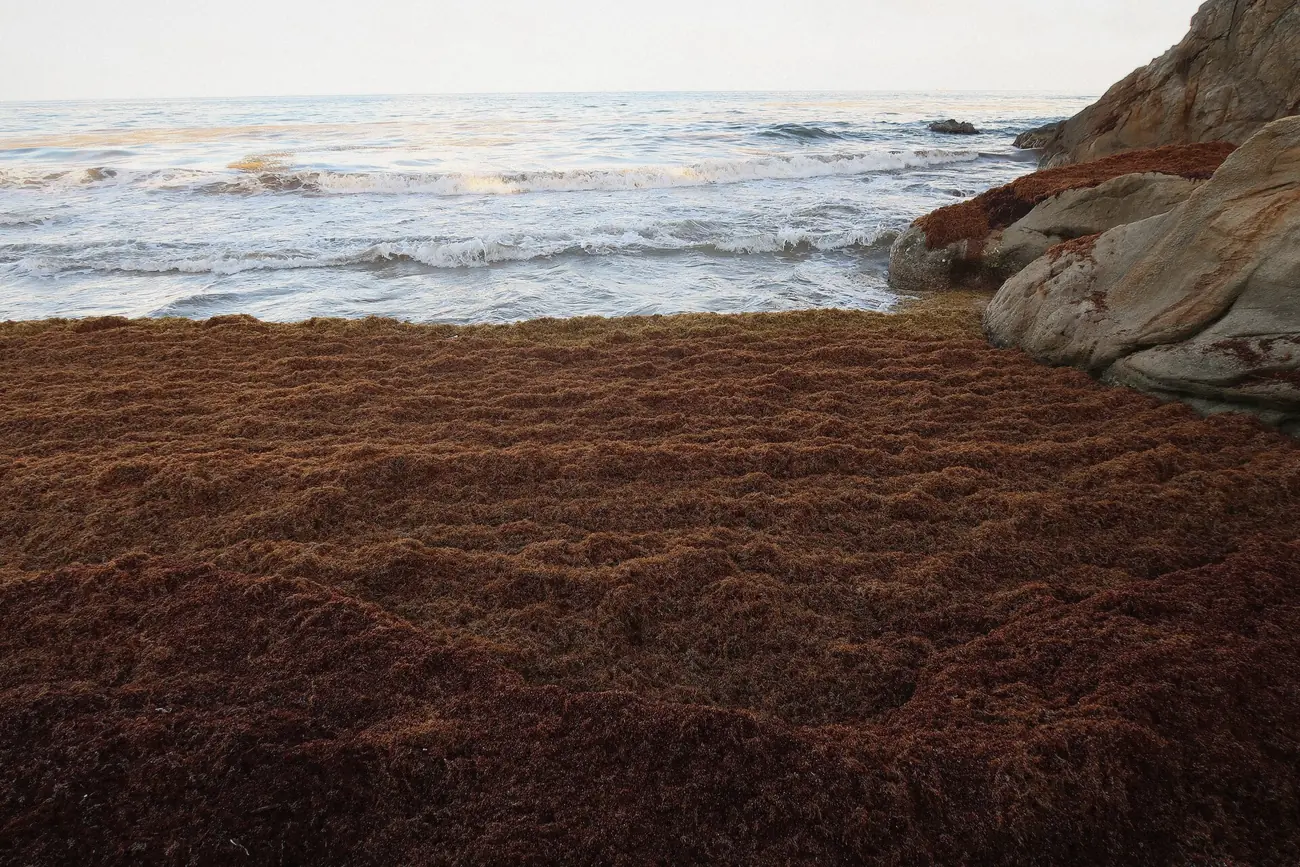
Illustrative photo. What a heavy sargassum landing looks like up close. Photo: BrickLightning (CC0) via Wikimedia Commons
The whale shark window, late May to mid-September
One season inverts the usual advice. For a few summer months, the best snorkeling near Cancun is not on the reef at all.
What happens and when
Whale sharks gather in the open water north of Isla Mujeres from late May to mid-September, feeding at the surface. This is a snorkeling encounter in the true sense, at the surface, fins on, beside an animal the size of a bus. The season sits squarely inside the warm-water block, with sea temperatures of about 29 C (84 F), and it overlaps the heart of hurricane season, so the same cancellation discipline applies.
Where to go deeper
This window has its own logistics, its own licensing and its own etiquette, so we cover it in full in our dedicated guide to whale shark snorkeling near Cancun. If your travel dates fall anywhere between late May and mid-September and swimming with whale sharks is on your list, that guide is the place to start. The protected waters of the Mexican Caribbean are managed by CONANP, the national parks commission, which sets the rules these encounters run under.
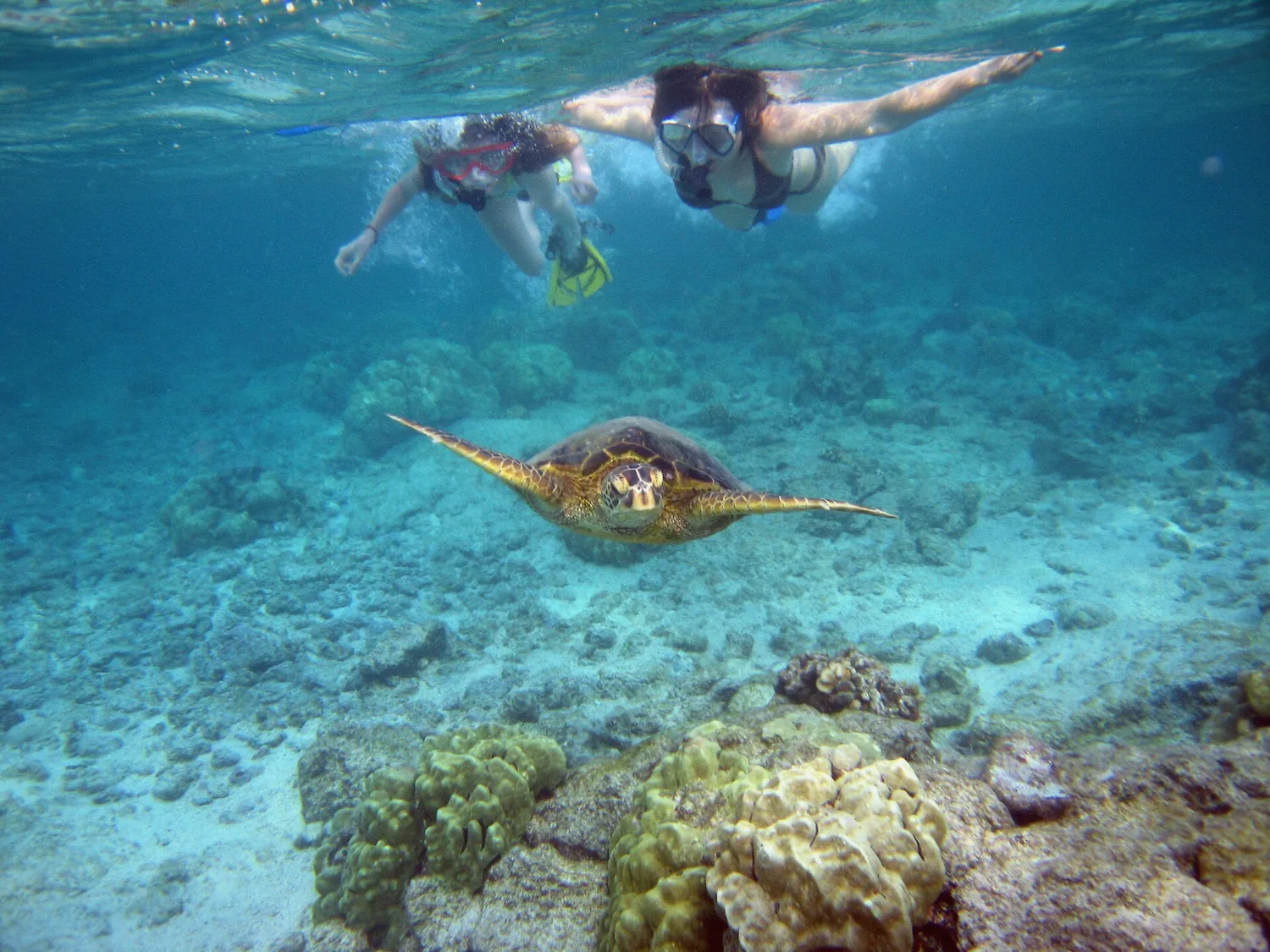
Illustrative photo. Turtle encounters like this one run all year on the Cancun trips. Photo: Vlad & Marina Butsky (CC BY 2.0) via Wikimedia Commons
Crowds and prices through the year
Timing is not only about water. It is also about how many other snorkel masks you share the reef with and what a ticket costs when you arrive.
The busy block and its exceptions
December to April and the Easter weeks are the crowded, priciest weeks in Cancun, and the catamaran listing flags itself as likely to sell out in high season. That is a pattern, not a verdict. The shoulder months, November and May, soften both the crowds and the prices while keeping most of the water quality, which is why we keep returning to them as the smart traveler's window.
If your dates are locked into high season, the fix is booking earlier and leaning toward small-group formats, since the five-stop boat runs parties of five to six against the 40-person boats on the same water. The cheapest and riskiest stretch to book is the tail of the season: September and October bring the lowest prices on the water and the highest chance a forecast rewrites your plans.
The price spread across the catalog
Ticket prices in our comparison are set by the operators, not by the season, so the spread you in the sections that follow holds as a baseline whatever month you travel. High-season demand affects availability first and price second, usually through surcharged options and sold-out slots rather than a different sticker on the same tour. Here is the field, sorted from cheapest to most expensive.
Every trip, cheapest first
| Trip | Price | Duration | Rating |
|---|---|---|---|
| Isla Mujeres catamaran | $35 per person | 8 hours | 4.2 (3,316 reviews) |
| Speedboat jungle tour | $51 per person | 3 hours | 4.5 (183 reviews) |
| MUSA museum snorkel | $80 per person | 2 hours | 3.5 (4 reviews) |
| Tulum ruins, cenote, turtles | $83 per person | 10 hours | 4.5 (370 reviews) |
| Reef & MUSA boat snorkel | $99 per person | 3 hours | 4.6 (41 reviews) |
| Puerto Morelos reef snorkel | $104 per person | 2 hours 30 minutes | not stated |
| Private half-day catamaran | $1,750 per group up to 25 | 4 hours | not stated |
Hidden costs by season and by trip
Some fees ride on top of the ticket regardless of when you go, and a few depend on which tier you pick. The catamaran charges a $20 per person port fee at the dock on every tier. The Tulum day collects $40 per adult and $25 per child in Tulum site and park fees at boarding, not in the ticket.
On the MUSA museum run, photos or videos per couple cost about $85 on site and a wetsuit is $10, both payable to the operator. By contrast, the $51 jungle tour already includes its $20 port fee and marine-park tax, the Puerto Morelos trip includes its $10 (300 MXN) dock and reef conservation fee, and the private catamaran includes its $20 per person docking fee. Budget the add-ons in any month.
They do not move with the calendar.
Data currency
These figures are drawn from the listings in our comparison and were
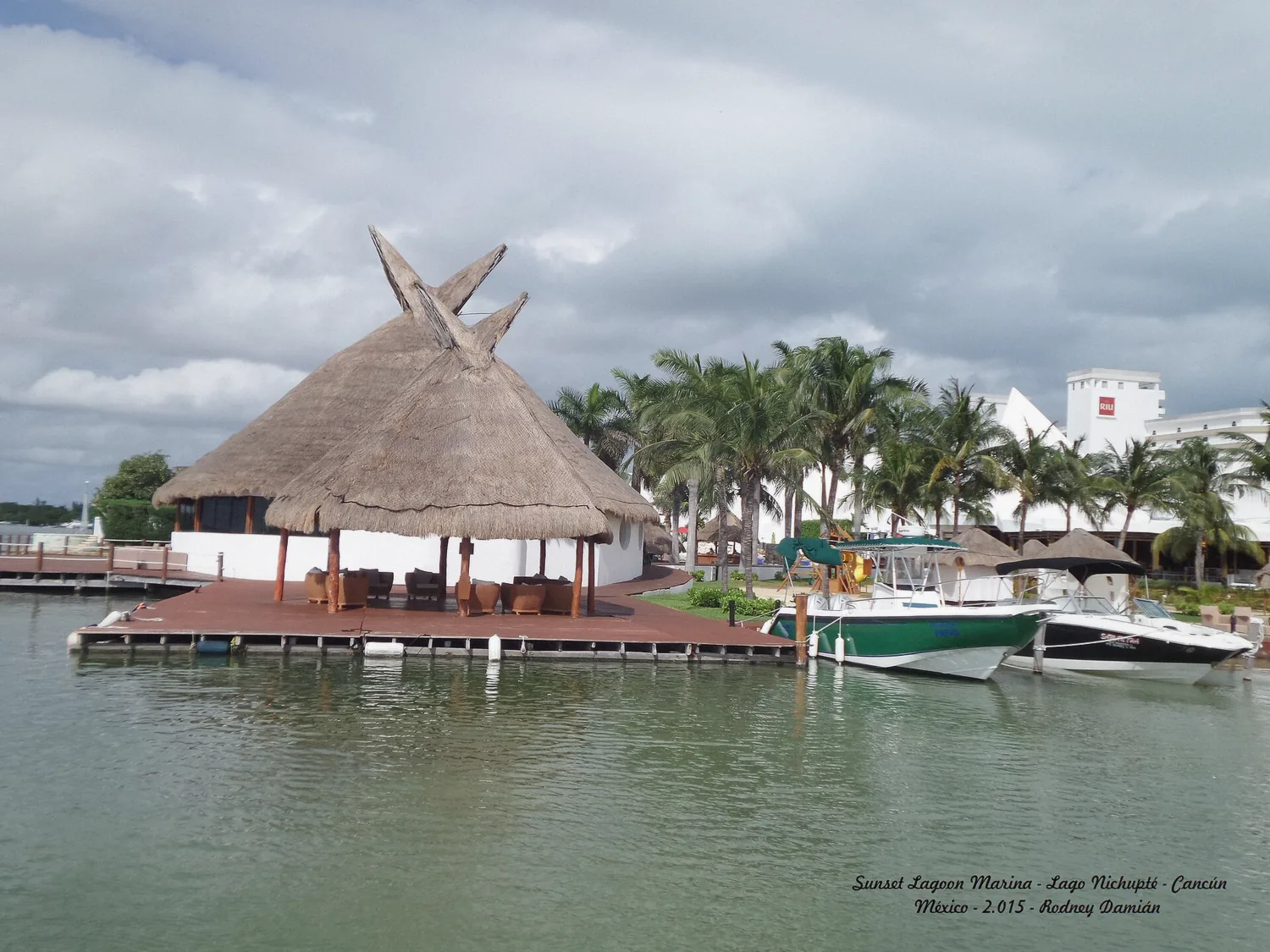
Sunset over the lagoon marina, where the Hotel Zone boats tie up. Photo: Rodney Damián (CC BY-SA 3.0) via Wikimedia Commons
Matching the season to the right trip
Once you know your month, the next question is which trip fits it. Every listing in this comparison break down cleanly by season and by intent, and you can compare all Cancun snorkeling trips side by side on our homepage when you are ready to commit.
Dry season, December to April
Calm, clear water is the dry season's gift, and it suits every format. The strongest fit is the five-stop Reef & MUSA boat snorkel at $99, the highest-rated listing in the comparison at 4.6 across 41 verified reviews, which packs El Meco reef, the MUSA statues, a resident turtle spot, a shipwreck and an underwater cenote into three hours. El Meco itself sits 8 to 12 feet down with little current, a beginner-friendly shelf that rewards the season's best visibility.
If you want the statues with a museum-first route, the MUSA museum snorkel spends both immersions there for $80. And for the fullest day on the water, the Isla Mujeres catamaran from $35 adds a 30-minute reef stop to a beach day on Playa Norte.
Summer, June to October
The warm 29 C (84 F) water and the whale shark season define this block. Reef trips run as normal, with the weather-clause discipline from the hurricane section. The speedboat jungle tour at $51 is a good summer pick because its one-hour snorkel at Punta Nizuc sits on the sheltered edge of the barrier reef, and driving your own two-person boat through the Nichupte mangroves is half the fun.
For turtles without leaving the region, the Tulum ruins, cenote, turtles day runs rain or shine and ends with a guided hour with the wild turtles of Akumal Bay.
Shoulder months, May and November
This is where the private half-day catamaran earns its place. Four hours instead of eight, your group of up to 25 only, El Meco reef with its underwater statues, Playa Norte and an open bar, at $1,750 total or about $70 per person at full capacity, with the $20 docking fee and hotel-to-marina transport included. In the shoulder months you get the calm-water experience of the high season without fighting a shared boat for rail space.
Its sargassum-free swimming guarantee is worth having in May specifically, as the landing window opens.
No-logistics option for any month
If you would rather not think about any of this, the Puerto Morelos reef snorkel removes the decisions. A van collects you at your Cancun hotel at about 11:30 am for a 2.5-hour run on a shaded speedboat to two reef sites less than a mile offshore on the Mesoamerican Barrier Reef, with the $10 (300 MXN) dock and reef tax already in the $104 ticket. It is a new listing with no platform rating yet, and the instructor works in Spanish, both worth knowing before you book rather than after.
Season-to-trip cheat sheet
| Window | Best fit | Why |
|---|---|---|
| December to April | Reef & MUSA boat snorkel ($99) | Calmest, clearest water for the five-stop route |
| Late May to mid-September | Whale shark trips (see dedicated guide) | Whale sharks north of Isla Mujeres |
| June to October | Speedboat jungle tour ($51) | Warm 29 C (84 F) water, sheltered Punta Nizuc stop |
| May and November | Private half-day catamaran ($1,750 per group) | High-season water, shoulder-season crowds, sargassum guarantee |
| Any month | Puerto Morelos reef snorkel ($104) | Hotel pickup, reef tax included, no logistics |
Illustrative photo. Small groups in calm shallow water, the dry-season ideal. Photo: Eli Duke from Portland, OR, USA (CC BY-SA 2.0) via Wikimedia Commons
Practical timing tips that apply in every month
A handful of rules hold regardless of when you travel. They are mostly about booking mechanics and small print, which is where trips are quietly won or lost.
Book with an exit
Free cancellation up to 24 hours in advance for a full refund is standard across every listing in this comparison, and Reserve Now and Pay Later is available on them too. Use both. Book early to lock your slot, especially in high season when the catamaran is flagged as likely to sell out, then keep the freedom to move your day if the forecast turns.
There is almost never a reason to accept a non-refundable rate on these trips.
Mind the booking deadlines
The MUSA museum snorkel asks you to book at least 12 hours ahead, and solo bookers on the Puerto Morelos trip should know the listing reschedules or refunds them if the day does not fill. Small print, but the kind that changes a plan at 9 pm the night before.
Pack for the season you chose
- Rashguard or long-sleeve shirt, since regular sunscreen is banned on the reef-protection boats
- Reusable water bottle, required inside the Tulum site where plastic bottles are not allowed
- Cash for on-site extras: about $85 per couple for photos on the MUSA run, $10 for a wetsuit there, tips
- Passport or ID for the catamaran, which the listing asks you to bring
- Seasickness precautions for the open-water runs, in any month but especially in afternoon trade winds
Read the edges of new listings
Two trips in the field are new to the platform. The MUSA museum snorkel has 3.5 across 4 reviews and the Puerto Morelos reef snorkel has no rating at all yet. Neither figure is a condemnation, it is a small sample, but in high season when every good slot is contested, the listings with deep review bases, the five-stop boat at 4.6 across 41 reviews or the Tulum day at 4.5 across 370, carry more evidence behind them.
In the quiet shoulder months you have more room to gamble on a fresh product at a lower effective price.
Where to Go Next
Where to go next on this site
Season picked, the next step is the boat: the five-stop reef and MUSA run is the morning trip this page keeps recommending, the MUSA museum snorkel holds its 11:30 slot in every season, and the spot-by-spot guide shows which reef each month treats best.
Frequently asked questions about when to snorkel in Cancun
Is the water too cold to snorkel in Cancun in winter?
No. Sea-surface temperatures from December through March hold around 26 C (79 F), and the dry season is precisely when the water is calmest and clearest. Most snorkelers wear no wetsuit at all in these months, though the MUSA museum run rents one for $10 on site if you run cold.
Which month has the clearest visibility underwater?
The listing data points to the dry season, December to April, as the calmest and clearest stretch. Within that block, mornings are the clearest hours, because trade winds rough up the surface as the day goes on.
Can I snorkel in Cancun during hurricane season without losing my money?
Hurricane season runs June to October, peaking August to October. Every trip in our comparison offers free cancellation up to 24 hours in advance for a full refund, and the MUSA museum run even allows a full refund if weather shifts the start by more than 30 minutes. Book those terms and a storm costs you nothing.
Do the reefs close at any time of year?
Nothing in the listings indicates seasonal closures of the snorkel sites. Boats run year-round on El Meco, Manchones, Punta Nizuc and the Puerto Morelos reef. What changes with the season is sea state, visibility and crowd levels, not access.
When should I avoid snorkeling because of seaweed on the beach?
Sargassum landings are worst roughly May to July on east-facing beaches, though no one can promise a clean beach in any week. The offshore reef sites are mostly unaffected and boats can re-route around slicks. The private half-day catamaran guarantees sargassum-free swimming water.
If I only have one week in Cancun, which days should I put my snorkel trips on?
Put them early in the week and in the morning. Booking early in your stay leaves room to rebook around weather, and morning departures catch the calmest sea in the trade-wind months. Keep one flex day unplanned and confirm the free-cancellation window when you book.